
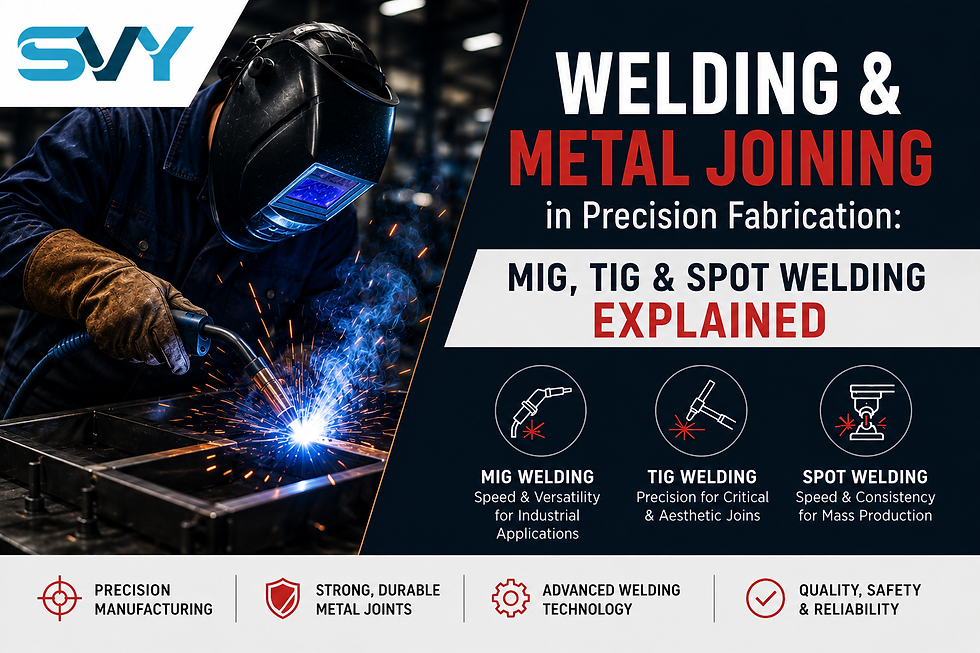
Welding & Metal Joining in Precision Fabrication: MIG, TIG & Spot Welding Explained

In the world of precision sheet metal manufacturing, laser cutting and CNC bending often take centre stage and rightly so. But no fabricated component is truly complete until it has been joined, reinforced, and structurally unified. That is where welding steps in. Often called the invisible backbone of manufacturing, welding and metal joining technologies are what transform individual cut and bent components into durable, load-bearing, industry-ready assemblies. At Supreme Laser Tech, welding is not an afterthought it is an integral part of the precision manufacturing journey.
Why Welding Is the Foundation of Structural Manufacturing
From automotive chassis and industrial enclosures to agricultural equipment frames and electrical panel boxes, virtually every metal assembly in modern industry depends on welding. Without reliable, high-strength joins, even the most precisely laser-cut components would remain individual pieces with no structural integrity. Welding bridges that gap creating permanent metallurgical bonds that can withstand vibration, thermal stress, mechanical load, and environmental exposure over decades of service life.
The quality of a weld determines the quality of the finished product. A poorly executed weld even on perfectly laser-cut parts will result in premature failure, warranty claims, and costly rework. This is why choosing a manufacturing partner with genuine welding expertise is just as critical as selecting one with advanced cutting machinery.
MIG Welding (GMAW): Speed and Versatility for Industrial Applications
Metal Inert Gas (MIG) welding, formally known as Gas Metal Arc Welding (GMAW), is one of the most widely used welding processes in industrial sheet metal fabrication. It uses a continuously fed wire electrode and a shielding gas typically a mixture of argon and CO₂ to create strong, clean welds at high speed. MIG welding is particularly well-suited to mild steel, stainless steel, and aluminium, making it the process of choice for high-volume production runs where cycle time and weld consistency matter.
In a modern fabrication facility, MIG welding is often paired with jigs and fixtures that hold laser-cut components in precise alignment during the welding process. This combination ensures dimensional repeatability across large production batches a critical requirement for industries such as automotive, material handling, and infrastructure where tolerances must be maintained part after part.
TIG Welding (GTAW): Precision for Critical and Aesthetic Joins
Tungsten Inert Gas (TIG) welding, or Gas Tungsten Arc Welding (GTAW), is the premium choice when weld quality, appearance, and metallurgical precision are paramount. Unlike MIG welding, TIG uses a non-consumable tungsten electrode and requires the welder to manually feed filler material with one hand while controlling the torch with the other a highly skilled process that demands years of training and steady hands.
TIG welding produces exceptionally clean, narrow, and aesthetically superior welds with minimal spatter and distortion. It is the preferred process for thin-gauge stainless steel fabrication, food-grade equipment, pharmaceutical machinery, aerospace components, and any application where the weld itself is visible and must meet cosmetic standards as well as structural ones. When clients require a product that is both strong and visually refined, TIG is the answer.
Spot Welding and Resistance Welding: Speed at Scale
For thin sheet metal assemblies particularly in enclosure manufacturing, electrical panel production, and automotive body parts spot welding and resistance welding offer unmatched speed and consistency. These processes use high electrical current passed through two copper electrodes to generate localised heat at the interface of overlapping metal sheets, forming a weld nugget in a fraction of a second.
Resistance welding requires no filler material, produces minimal heat-affected zones, and is easily automated for mass production. When combined with laser-cut and CNC-bent components, spot welding allows fabricators to assemble complex sheet metal enclosures and panels at rates that would be impossible with arc welding alone dramatically reducing per-unit assembly costs without sacrificing joint integrity.
The Role of Welding in Complete Fabrication Workflows
Welding does not exist in isolation it is the joining thread that connects every other step of the fabrication process. A typical precision manufacturing workflow at Supreme Laser Tech follows this integrated sequence:
design and engineering review → laser cutting of raw sheet metal → CNC bending and forming → welding and joining → grinding and surface finishing → industrial painting or powder coating → quality inspection and dispatch. Removing or compromising any one step weakens the entire chain.
This is why at Supreme Laser Tech, we treat welding as a precision discipline, not a commodity service. Our welding team works closely with our laser cutting and CNC bending operators to understand the downstream requirements of each assembly the fit-up tolerances, the load directions, the surface finish requirements before a single arc is struck. This upstream coordination eliminates rework, reduces distortion, and ensures that every welded assembly meets its engineering specification the first time.
Industries That Depend on Precision Welding
Automotive and EV Manufacturing: Body panels, battery enclosures, chassis brackets, and mounting structures all require welded joins that can withstand the vibration and thermal cycling of vehicle operation over hundreds of thousands of kilometres.
Agricultural Equipment: Tractors, harvesters, and irrigation systems are subjected to constant outdoor exposure, soil abrasion, and mechanical stress. Welded frames and structural members must be robust enough to work reliably season after season in India's diverse climatic conditions from the heat of Maharashtra summers to the monsoon rains of the Deccan plateau.
Electrical Enclosures and Control Panels: Industrial switchgear cabinets, junction boxes, and distribution panels fabricated from laser-cut sheet metal must be precisely welded to ensure IP-rated sealing, structural rigidity, and dimensional accuracy for component fit-out.
Infrastructure and Material Handling: Conveyors, storage racks, mezzanine platforms, and structural steelwork all rely on certified welding to meet load requirements and safety standards prescribed by industrial codes.
Quality Assurance in Welding: What to Look For in a Fabrication Partner
Not all welding is created equal. When evaluating a fabrication partner for welded assemblies, buyers should ask the right questions: Are the welders certified to relevant Indian or international standards? Does the facility use jigs and fixtures to ensure positional repeatability? What non-destructive testing (NDT) methods such as visual inspection, dye penetrant testing, or ultrasonic testing are applied to verify weld integrity? Is there a documented quality control process that traces each weld to the operator and process parameters used?
At Supreme Laser Tech, quality assurance is built into every stage of the welding process. From pre-weld fit-up inspection to post-weld dimensional checks and surface assessment, our processes are designed to catch and correct deviations before they reach the customer because in precision manufacturing, there is no acceptable substitute for getting it right.
Welding + Laser Cutting + CNC Bending: The Complete Manufacturing Ecosystem
The true competitive advantage of working with Supreme Laser Tech is not any single process it is the seamless integration of laser cutting, CNC bending, and welding under one roof in our Chakan facility near Pune. This single-vendor, end-to-end capability eliminates the logistics, delays, quality risk, and communication overhead that come with managing multiple subcontractors across the fabrication chain. Your raw material comes in one end, and a finished, welded, painted, and inspected assembly comes out the other on time, on specification, and ready to ship.
For manufacturers in Pune, Chakan, PCMC, and across Maharashtra looking for a reliable, technically capable, and quality-driven fabrication partner, Supreme Laser Tech is ready to discuss your welding and assembly requirements. Whether you need a single prototype welded assembly or a long-term production contract, our team brings the same precision, commitment, and craftsmanship to every job.
Reach out to Supreme Laser Tech today to request a quote or discuss your next fabrication project.


Comments